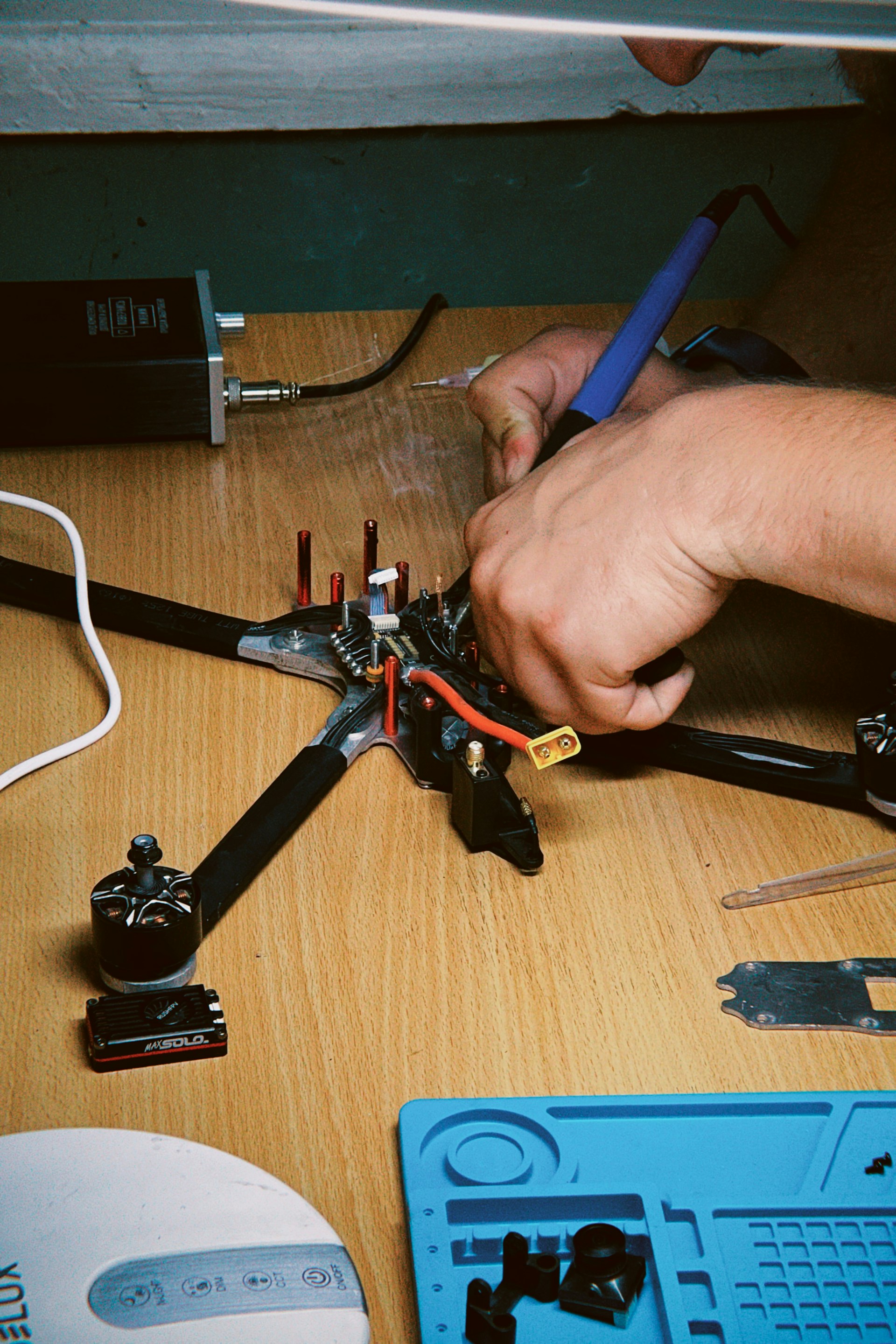
From battlefield to terror: how cheap technology brings the attack within reach
Drone, 3D printer and a list of targets
In the autumn of 2025, a case in Belgium drew the attention of Dutch security advisers. Three young men were arrested by Belgian justice authorities on suspicion of a religiously motivated attack on the Belgian prime minister. During house searches, investigators found homemade explosives, a 3D printer and a list of targets; according to reports, the suspects wanted to build a drone to deliver the explosives to the target by air.¹ The Dutch Terrorist Threat Assessment of December 2025 identified the case as a concrete West European illustration of a shift that had long been emerging in conflict zones. Within weeks, the Dutch House of Representatives raised questions about the protection of public figures and the Netherlands' preparedness for comparable scenarios.²
Where part one of this series zoomed in on drones operated by state actors above vital infrastructure, and part two on criminal applications around ports, the picture now tilts toward a third face: a terrorist threat via drones built with off-the-shelf components.

A history of drones and terror
That this is happening should come as no surprise. As early as January 2017, the Combating Terrorism Center at West Point documented how Islamic State had set up an organized drone programme in Mosul, complete with purchase lists, mission forms and modified commercial platforms for reconnaissance and attack.³ According to a Reuters source, Hamas deployed its own drone unit during the attack on Israel of 7 October 2023 to prepare the infiltration.⁴ Since late 2023, the Houthi movement in Yemen has waged a sustained campaign of drone and missile attacks on commercial shipping in the Red Sea and the Arabian Sea, resulting in sunken vessels and fatalities.⁵
What these actors share is their means: cheap, deployable modular technology that can be modified at will. The war between Russia and Ukraine lowers that threshold even further: FPV tactics, do-it-yourself payloads and attack patterns circulate openly via the internet, with manuals that are relatively quick to find online. Where (non-)state actors once depended on heavier means, they can now act with low-threshold tools.⁶
The impact of a single small device is enough
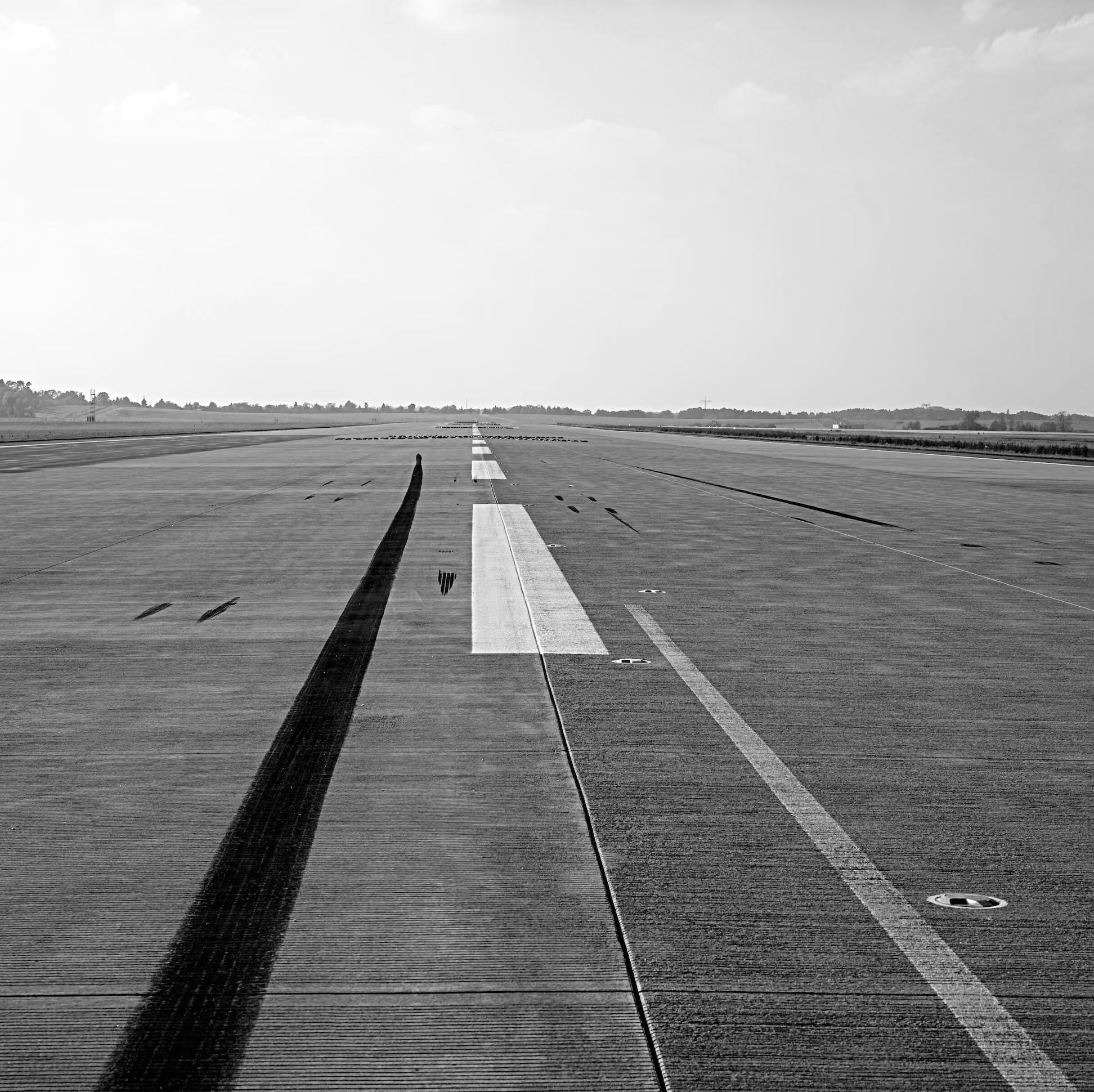
For the Netherlands, this shifts the composition of the threat picture. A densely populated country with international airports, EU and NATO facilities, urban hospitals and vital port infrastructure has a striking density of vulnerable locations. The impact of a single small device can be read from the Gatwick case of December 2018, when several unidentified drone flights caused considerable disruption, leading to thirty-three hours of standstill, more than a thousand cancelled flights and roughly 140,000 affected passengers.⁷ No advanced payload is needed for such an effect; the mere presence of a drone is enough.
In 2025, Europol warned that cheap drones are within reach of both criminal and terrorist actors.⁸ In early 2026, the European Commission presented an action plan against drone threats.⁹ The Dutch Terrorist Threat Assessment underlines that drones, 3D-printed components and manuals are widely accessible online.¹⁰ Airports and major ports are now investing in detection capacity; for energy hubs and hospitals, the picture remains stuck at the system level.
From threatassesment to crisis plan under time pressure
Those who prepare for a spectacular threat look past the actual disruption: a reconnaissance flight ahead of a ministerial visit, a small payload above an open event, or a drone that jams hospital communications while an ambulance convoy arrives. In short: it takes little to cause chaos and disruption. Many organizations have reporting protocols, sometimes detection capacity. What rarely exists is a translation of the broader threat picture into a location-specific scenario of their own.
Three questions determine whether that layer is present: which actors with a low-threshold drone option have an interest in my sector? Which combination of means and location yields the greatest impact? And who has the authority to escalate from observation to incident? That analysis requires intelligence work, sector knowledge and exercise discipline. At Proximities, we build threat pictures for private parties, translate them into scenarios for state and non-state actors using low-threshold means, and exercise these in crisis plans that hold up under time pressure when escalation occurs.

The strategic challenge
Dutch executives often look for a report they can sign off on once. Proximities' approach is that a drone threat picture is continuously fed by operational signals: incidents in neighbouring countries, technological shifts in the commercial segment, and the intentions of domestic and foreign actors (both state and non-state) that you do not yet know. A static threat picture is, after six months, a security risk. In short: a current threat picture is not a product, but a process.
Executives design crisis plans for scenarios they know. Proximities trains specifically for the uncertainty: when the object is unidentified, the intent is unknown, and the political pressure to act has already begun. In other words: the decision chain can already fail on the first unknown fact.
In just a few years, drones have shifted from a military instrument to a tool that sits on a hobby-shop shelf. The strategic challenge for Dutch executives lies not in detection equipment, but in what must come before it: a threat picture of one's own, trained decision chains for escalation, and a crisis plan that holds up when the first report is still unclear. Ultimately, the difference is made not by technology, but by the choices already locked in today.

Sources
¹ NCTV, “Dreigingsbeeld Terrorisme Nederland – December 2025,” 9 december 2025, https://www.nctv.nl/documenten/2025/12/09/dtn-december-2025.
² Tweede Kamer, “Kamervragen over voorkomen terroristische aanslag met drone op politici in België,” 24 november 2025, https://www.tweedekamer.nl/downloads/document?id=2025D47962.
³ Combating Terrorism Center at West Point, “The Islamic State’s Drone Documents: Management, Acquisitions, and DIY Tradecraft,” 31 januari 2017, https://ctc.westpoint.edu/ctc-perspectives-the-islamic-states-drone-documents-management-acquisitions-and-diy-tradecraft/.
⁴ Reuters, “Hamas deployed specialised units to attack Israel, says source,” 9 oktober 2023, https://www.reuters.com/world/middle-east/hamas-deployed-specialised-units-attack-israel-says-source-2023-10-09/.
⁵ Reuters, “Yemen’s Houthis say they targeted ship in Arabian Sea with drones,” 18 oktober 2024, https://www.reuters.com/world/middle-east/yemens-houthis-say-they-targeted-ship-arabian-sea-with-drones-2024-10-18/.
⁶ Combating Terrorism Center at West Point, “On the Horizon: The Ukraine War and the Evolving Threat of Drone Terrorism,” maart 2025, https://ctc.westpoint.edu/on-the-horizon-the-ukraine-war-and-the-evolving-threat-of-drone-terrorism/.
⁷ European Union Aviation Safety Agency, “Drone Incident Management at Aerodromes,” 8 maart 2021, https://www.easa.europa.eu/sites/default/files/dfu/drone_incident_management_at_aerodromes_part1_website_suitable.pdf.
⁸ Europol, “The Unmanned Future(s): The impact of robotics and unmanned systems on law enforcement,” 2025, https://www.europol.europa.eu/publication-events/main-reports/unmanned-futures.
⁹ Europese Commissie, “New plan to counter drone threats,” 11 februari 2026, https://commission.europa.eu/news-and-media/news/new-plan-counter-drone-threats-2026-02-11_en.
¹⁰ NCTV, “Dreigingsbeeld Terrorisme Nederland – December 2025,” 9 december 2025, https://www.nctv.nl/documenten/2025/12/09/dtn-december-2025.
Stay ahead
subscribe to ourinsights
Subscribe to our monthly insights and receive the latest security insights straight to your inbox