
From Battlefield to Smuggling Route: How War Drones Are Reaching European Logistics
A new category of risk
In late January 2026, Europol issued a striking warning: international criminal drug organisations are now deploying drones, unmanned vessels and even submersibles to bypass European port controls.¹ What was for a long time the domain of military units now lies within reach of organised crime. The DZ Mafia, for example, secures its smuggling routes in Marseille with thermal drones, combined with GNSS jammers that disrupt the local signal environment.²
The line between foreign war and internal undermining is blurring visibly. For Dutch ports, logistics hubs and vital infrastructure, this means a new category of risk: one that originated on battlefields far away, but is landing in Rotterdam and Vlissingen.
Military technology repurposed
This shift is not a future scenario, but a pattern we already see today. It is a classic second-order effect: military technology consistently spreads to other markets after a conflict, including where that was never the intention. With drones, this happens faster than before, because the hardware and knowledge are largely civilian. The lead time is short: where in earlier conflicts it took years for such innovations to find their way into society, this now unfolds in months via the internet, international networks and commercial drone suppliers.
The Atlantic Council documented in September 2025 that Mexican cartels are actively adopting drone techniques from the Ukrainian conflict; there are indications that cartel operatives travel to Ukraine to learn drone tactics in the field.³ A month later, the global research network Global Initiative Against Transnational Organized Crime concluded that organised crime is now deploying drones in the air, on land and underwater, and warned explicitly that this knowledge is finding its way beyond the battlefield at extraordinary speed.⁴
The Dutch threat assessment for critical infrastructure published in November 2025 confirms the same dynamic on this side of the ocean: commercially available drones and DIY kits are easily accessible to malicious actors.⁵

The Netherlands as a critical hub
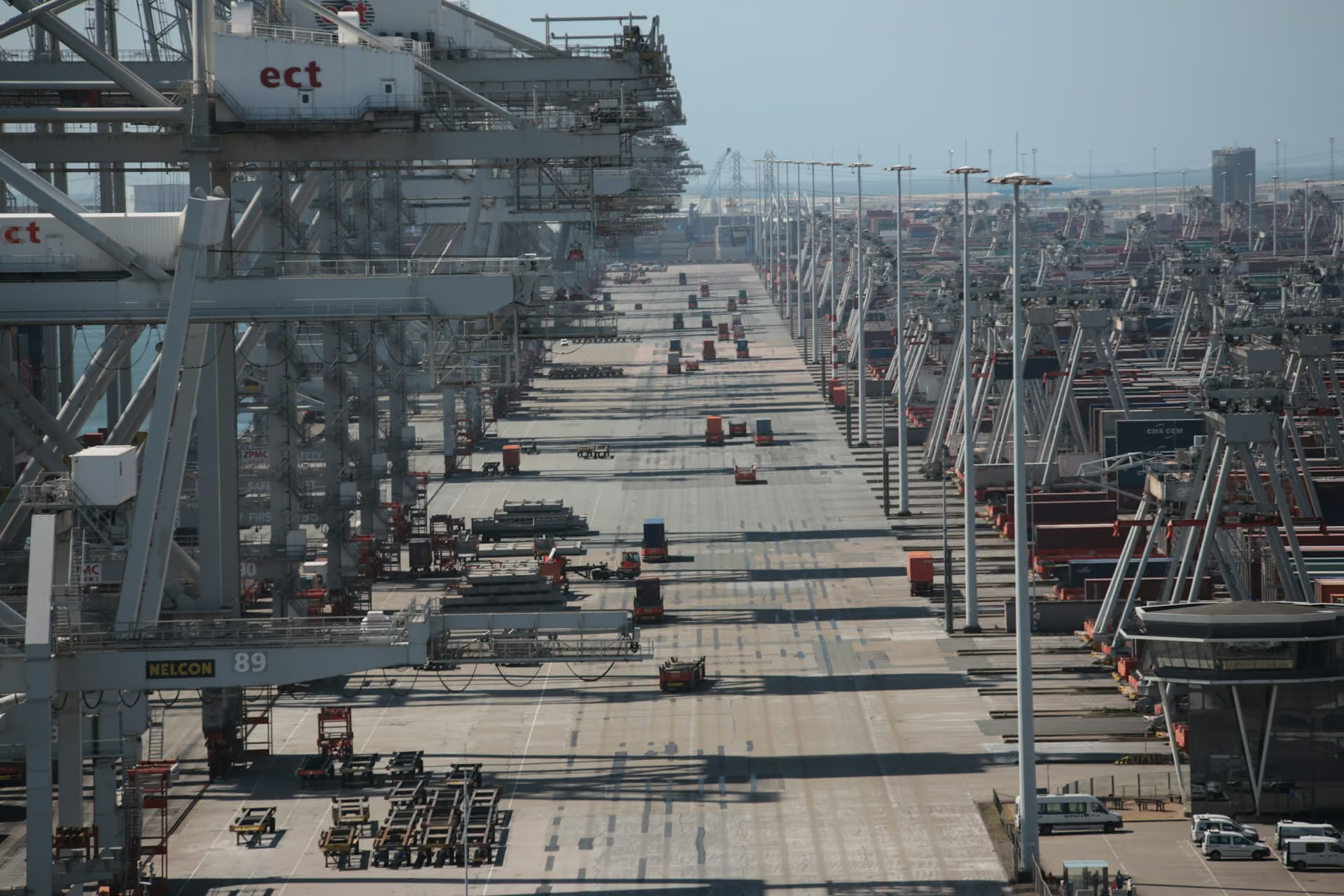
For Dutch vital sectors, this means a fundamental shift in the threat picture. Our ports form a hub in global goods flows, and that position makes them attractive to criminal drone operations. Spanish authorities dismantled a network in 2022 that deployed underwater drones specifically designed for cocaine transport across the Strait of Gibraltar, with loads of up to eight hundred kilos per shipment.⁶ The same modus operandi fits the scale and infrastructure of Rotterdam and Antwerp.
Beyond these two main gateways, the logistics map shows second-line vulnerabilities: regional container terminals, inland waterway hubs and distribution centres that operate in the shadow of the major ports but handle the same goods flows. The Belgian ports launched the Port 2 Port Security Platform in November 2025, focused specifically on drug smuggling, cyber sabotage and drone misuse against port installations.⁷ A few months later the European Commission published an action plan against unmanned systems, noting that drones constitute a “growing, multifaceted threat” to critical infrastructure and border control.⁸
The consequences reach beyond smuggling alone. The same drone that can monitor a smuggling route can also bypass surveillance cameras, map vulnerable points in a terminal or disrupt communications around an installation. What today is a drone observing a transport route may tomorrow be a drone bringing a distribution centre, a drinking water intake or a hospital location into view for later disruption.

Drones bypass traditional models
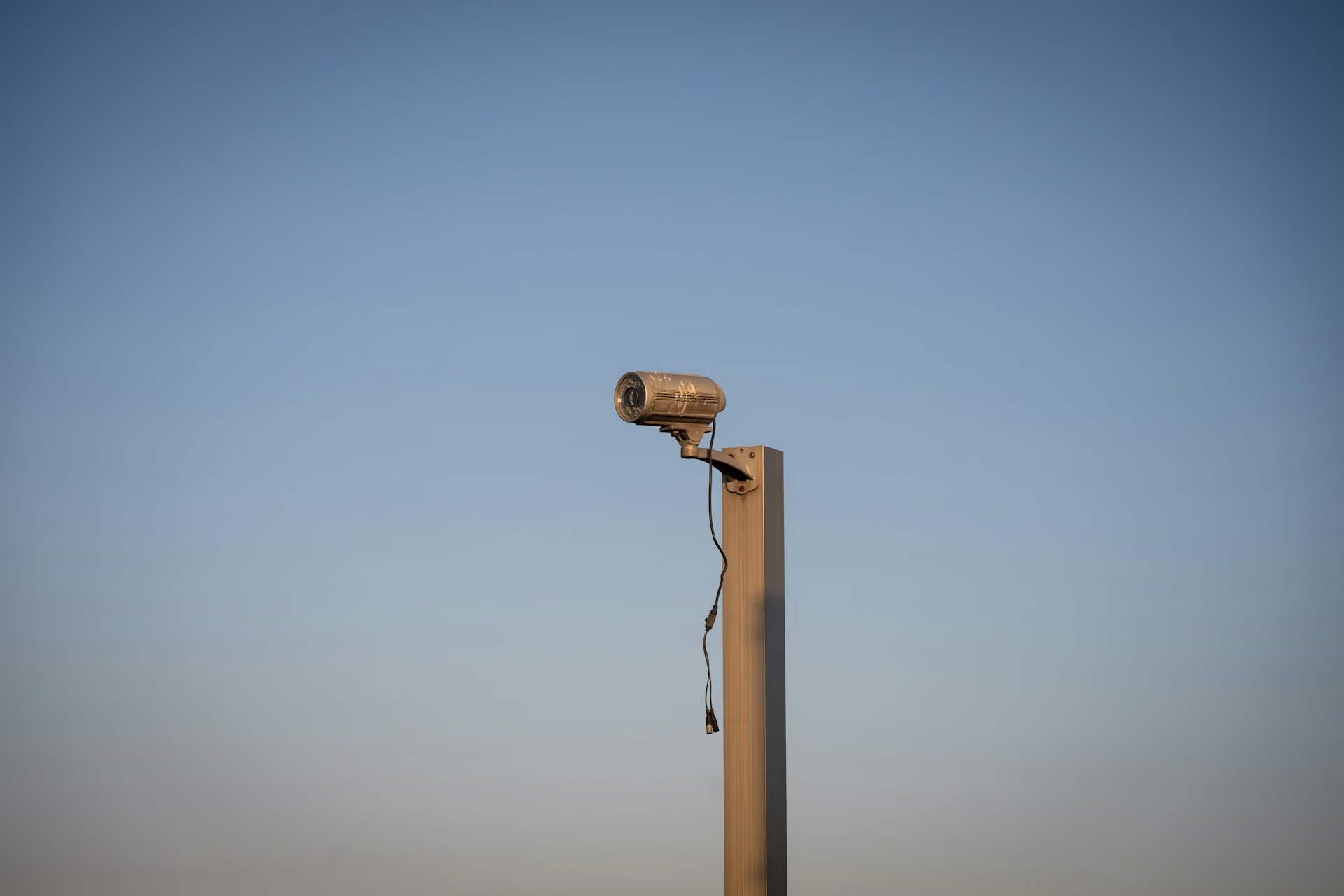
The distance between the current security picture at many logistics and industrial organisations and the actual threat is wide. Traditional models relied on visible intrusion: fences, cameras, guards. Drones literally bypass that layer. Some port operators are now exploring drone detection and countermeasures. The government provides structural threat assessments for its own domains, but without organisation-specific translation those analyses remain at system level; meanwhile the market for detection technology is growing faster than the interpretation of what is flying above one’s own perimeter.
This development calls for a concrete picture of where the threat pattern touches the organisation’s own operation. Which locations, processes or links in the chain become visibly more attractive when drones are deployed? Without that translation, the risk remains abstract while the application is in fact very tangible. That also means having clarity in advance about when a signal acquires meaning. At what moment does an observation become an incident, and what does that mean for decision-making and escalation? In that transition lies most of the uncertainty and the greatest time pressure.
The starting point also shifts in the design of infrastructure and processes. Existing security is largely set up for visible and physical threats, while unmanned systems partly evade those. Organisations that take this into account in their considerations strengthen their ability to move with that shift.
Prepare before the pattern lands here
The drone war now being fought between Ukraine and Russia will, within a few years, be the security question facing every European port. We can already see this in Marseille, Cádiz and along the Mexican border.
For Dutch leaders, the strategic task lies in preparation: knowing how the threat picture is developing, and who keeps that picture sharp before the first incidents arrive. Those who invest now in clear interpretation buy themselves the time to avoid reactive policy when the same pattern lands here.

Sources
¹ Belga News Agency, “Drug gangs turn to drones and submarines to bypass port controls, says Europol,” 27 January 2026, https://www.belganewsagency.eu/drug-gangs-turn-to-drones-and-submarines-to-bypass-port-controls-says-europol.
² Intelligence Online, “French drug gang DZ Mafia resorting to thermal drones and GNSS jamming,” 10 March 2026, https://www.intelligenceonline.com/europe-russia/2026/03/10/french-drug-gang-dz-mafia-resorting-to-thermal-drones-and-gnss-jamming,110676568-art.
³ Atlantic Council, “Drug cartels are adopting cutting-edge drone technology. Here’s how the US must adapt,” 16 September 2025, https://www.atlanticcouncil.org/blogs/new-atlanticist/drug-cartels-are-adopting-cutting-edge-drone-technology-heres-how-the-us-must-adapt/.
⁴ Global Initiative Against Transnational Organized Crime, “Crime by Drone: A new paradigm for organized crime?,” 30 October 2025, https://globalinitiative.net/analysis/crime-by-drone-a-new-paradigm-for-organized-crime/.
⁵ NCTV, “The Critical National Infrastructure Threat Landscape,” 14 November 2025, https://english.nctv.nl/site/binaries/site-content/collections/documents/2025/11/14/the-critical-national-infrastructure-threat-landscape/84346-NCTV-Dreigingsbeeld+Vitale+Infrastructuur-ENG_TG-UA+def.pdf.
⁶ OCCRP, “Spain Dismantles Gang Making Underwater ‘Drug Drones’,” 11 July 2022, https://www.occrp.org/en/news/spain-dismantles-gang-making-underwater-drug-drones.
⁷ Port of Antwerp-Bruges, “Belgian ports join forces for integrated port security,” 21 November 2025, https://newsroom.portofantwerpbruges.com/en/press-releases/belgian-ports-join-forces-for-integrated-port-security.
⁸ European Commission, “Action Plan on Drone and Counter Drone Security,” 12 February 2026, https://digital-strategy.ec.europa.eu/en/policies/drone-security.
Stay ahead
subscribe to ourinsights
Subscribe to our monthly insights and receive the latest security insights straight to your inbox